Please note: This website contains affiliate links. As an Amazon Associate, we earn from qualifying purchases at no additional cost to you.
Quick Answer: Most adults need about 44–78 grams of fat a day on a 2,000-calorie diet, mostly from unsaturated sources like olive oil, avocado, nuts, and fatty fish. Pairing fat with protein at meals isn’t just a texture thing — fat helps your body absorb fat-soluble vitamins and can slow digestion in a way that keeps you fuller longer. It doesn’t have to come from any one food, and it definitely doesn’t need to be avoided.
Why Did I Spend So Long Thinking Fat Was the Enemy?
Most of my adult life, fat was the villain on every food label. Low-fat this, fat-free that — I can still picture the packaging. Somewhere along the way “fat” and “unhealthy” became the same word in my head, and even now, knowing better, there’s still a small voice that hesitates before I drizzle olive oil on something or eat the yolk instead of just the egg white.
The research has moved on even though that instinct hasn’t fully caught up. It’s not that fat is good or bad across the board — it’s that the type of fat matters far more than the total amount, and the foods we spent decades avoiding turned out to be some of the most useful ones in the fridge.
Why Do I Actually Need Healthy Fat?
- Hormone production — several hormones, including estrogen and testosterone, are built from cholesterol and fat
- Vitamin absorption — vitamins A, D, E, and K are fat-soluble, meaning your body can’t absorb them properly without some dietary fat present
- Cell structure — every cell membrane in your body relies on fat to stay intact and functional
- Brain function — roughly 60% of the brain is fat, and omega-3s in particular are tied to cognitive health
- Satiety — fat slows digestion, which is a big part of why a meal with some fat in it keeps you full longer than one without
What Actually Counts as a “Healthy” Fat?
- Monounsaturated fats — olive oil, avocado, most nuts; linked to better cholesterol levels
- Polyunsaturated fats (including omega-3s) — fatty fish, walnuts, flaxseed, chia seeds; support heart and brain health
- Saturated fats — butter, red meat, coconut oil; not “bad” outright, but best kept to a smaller share of total intake
- Trans fats — found in some fried and heavily processed foods; this is the one category worth actually avoiding
What Are the Best Sources of Healthy Fat?
Monounsaturated fat sources:
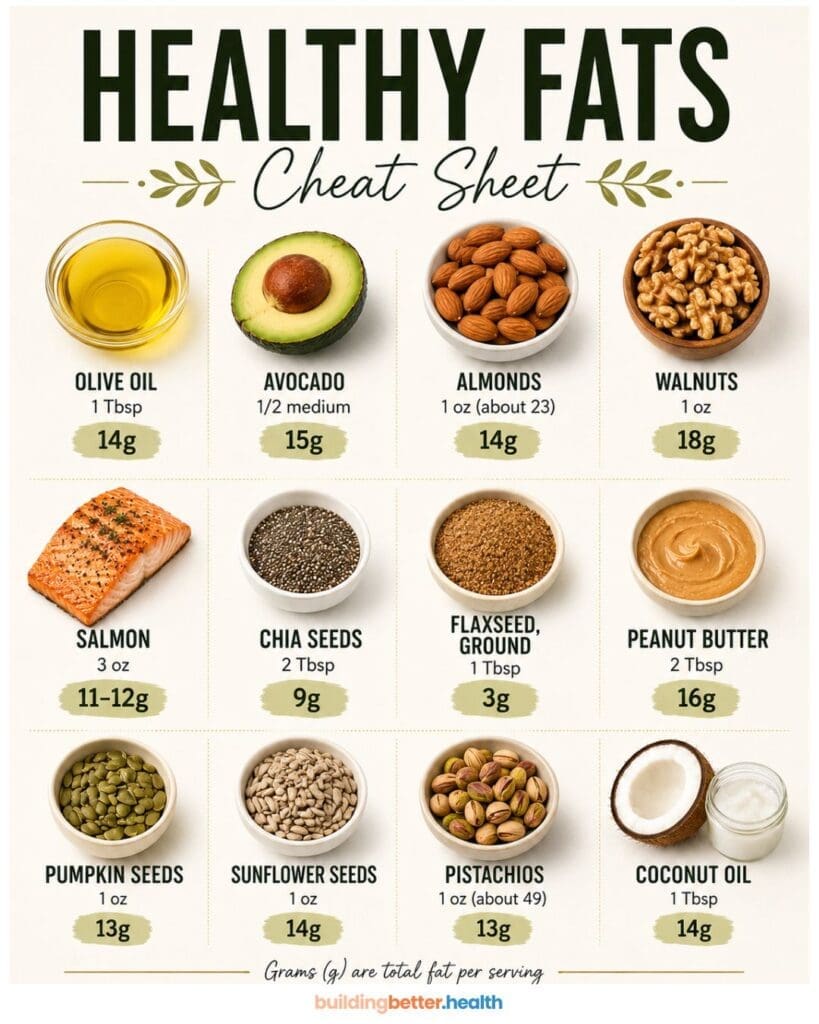
| Food | Serving | Fat (g) |
|---|---|---|
| Olive oil | 1 tbsp | 14 g |
| Avocado | 1/2 medium | 15 g |
| Almonds | 1 oz | 14 g |
| Peanut butter | 2 tbsp | 16 g |
Polyunsaturated fat sources (omega-3s):
| Food | Serving | Fat (g) |
|---|---|---|
| Walnuts | 1 oz | 18 g |
| Salmon | 3 oz | 11–12 g |
| Chia seeds | 1 oz (2 tbsp) | 9 g |
| Flaxseed, ground | 1 tbsp | 3 g |
How Much Healthy Fat Do I Need Per Day?
On a 2,000-calorie diet, most adults land in the range of 44–78 grams of total fat per day, based on getting 20–35% of calories from fat. Within that:
- Saturated fat: aim to keep it under about 22 grams (roughly 10% of calories)
- Omega-3s (ALA): 1.1 grams/day for women, 1.6 grams/day for men, from sources like walnuts, flaxseed, or chia seeds
- Omega-3s (EPA/DHA): most health organizations suggest 250–500 mg/day combined, which is roughly what you’d get from two servings of fatty fish a week
A tablespoon of olive oil, a quarter cup of almonds, half an avocado, and a serving of salmon add up to close to 60 grams on their own — mostly from the unsaturated column.
Should I Pair Fat With Protein? Does It Help Absorption?
Yes, and it’s one of the more underrated pairings in everyday eating. Fat slows how quickly a meal moves through your digestive system, which means the protein in that same meal gets digested and absorbed more steadily instead of all at once. It also means fat-soluble vitamins in a meal — think the vitamin A in sweet potatoes or the vitamin E in leafy greens — actually get absorbed rather than passing through unused.
In practice, this just looks like normal cooking: olive oil on roasted vegetables, avocado alongside eggs, a handful of nuts with a piece of fruit. You don’t need to engineer it — most traditional meals already pair the two.
Eating Enought Healthy Fat Per Day: Frequently Asked Questions
Is it possible to eat too much healthy fat?
Yes, even unsaturated fats are calorie-dense at about 9 calories per gram, so portion still matters. The bigger issue for most people is getting too much saturated fat relative to unsaturated, not eating too much fat overall.
Do I need to count fat grams every day?
Not usually. Focusing on the type of fat — leaning toward olive oil, nuts, avocado, and fatty fish over butter and processed fried foods — matters more day to day than hitting an exact gram target.
Can I get enough omega-3s without eating fish?
Partially. Plant sources like walnuts, chia seeds, and flaxseed provide ALA, but your body converts only a small percentage of ALA into the EPA and DHA forms found directly in fatty fish, so a fish-free diet may still fall short on those specifically.
Why did no fat and low-fat foods become so popular in the first place?
Dietary guidance in the late 20th century linked saturated fat to heart disease and, at the time, recommended cutting fat broadly rather than distinguishing between types. Research since then has refined that picture considerably, but a lot of food packaging and habits never fully caught up.
If I’m trying to lose weight, should I reduce my healthy fat intake?
Not aggressively. Fat is calorie-dense at 9 calories per gram, so trimming portions of it can help create a calorie deficit, but cutting it too low often backfires — fat is a big part of what keeps you full, so going too low tends to increase hunger and overeating elsewhere. Staying within the general 20–35%-of-calories range while creating your deficit through overall portions tends to work better than eliminating fat specifically.
Is there a difference in the type of olive oil I use? Do some have healthier fats than others?
The fat content and calories are essentially the same across every grade of olive oil — extra virgin, “light,” and refined all provide the same monounsaturated fat per tablespoon. The real difference is polyphenols, the antioxidant compounds tied to olive oil’s health reputation. Extra virgin is mechanically pressed with no heat or chemical processing, so it retains most of its polyphenols; refined, “light,” and “pure” olive oils go through heat and chemical processing that strips most of that out, even though the fat itself is unchanged.
BONUS:
Which Olive Oil Brands Are Actually Worth Buying?
If you’re shopping for a reliable extra virgin olive oil, these are five brands worth keeping in the cart:
- California Olive Ranch — a dependable, widely available everyday extra virgin with verified California sourcing
- Cobram Estate — an Australian brand that regularly wins international quality awards and tests higher in polyphenols than most supermarket oils
- Bragg Organic Extra Virgin Olive Oil — a familiar health-food-store name for anyone already stocking up on wellness staples
- Colavita Extra Virgin Olive Oil — a long-established Italian brand that’s affordable and easy to find
- Graza — a newer, trendy option in squeeze bottles, popular for both cooking and finishing
Please note: This website contains affiliate links. As an Amazon Associate, we earn from qualifying purchases at no additional cost to you.