Please note: This website contains affiliate links. As an Amazon Associate, we earn from qualifying purchases at no additional cost to you.
Quick Answer: If a glass of milk isn’t your thing but you need more daily calcuim, you’re not stuck. Yogurt, hard cheeses like Swiss and Parmesan, and kefir deliver just as much calcium as milk—sometimes more. Avoiding dairy altogether? Sardines, calcium-set tofu, dark leafy greens, tahini, and fortified OJ can get you to your daily target just as easily.
The 1,000 mg Target: Why Variety Beats Milk Every Time
Milk gets all the credit, but it’s far from the only—or even the most concentrated—source of calcium available. Since your body relies on a steady intake of calcium to protect bone density and power muscle function, relying on a single food group often leads to nutrition burnout.
Whether you’re lactose-intolerant, plant-based, or just tired of drinking plain milk, hitting your 1,000 mg daily goal comes down to mixing and matching across different food groups.
So What Can I Eat Instead of Milk If I Still Want Dairy?
If cheese and yogurt are more your speed than a glass of milk, you’re already set—most of these match or beat milk’s calcium content per serving:
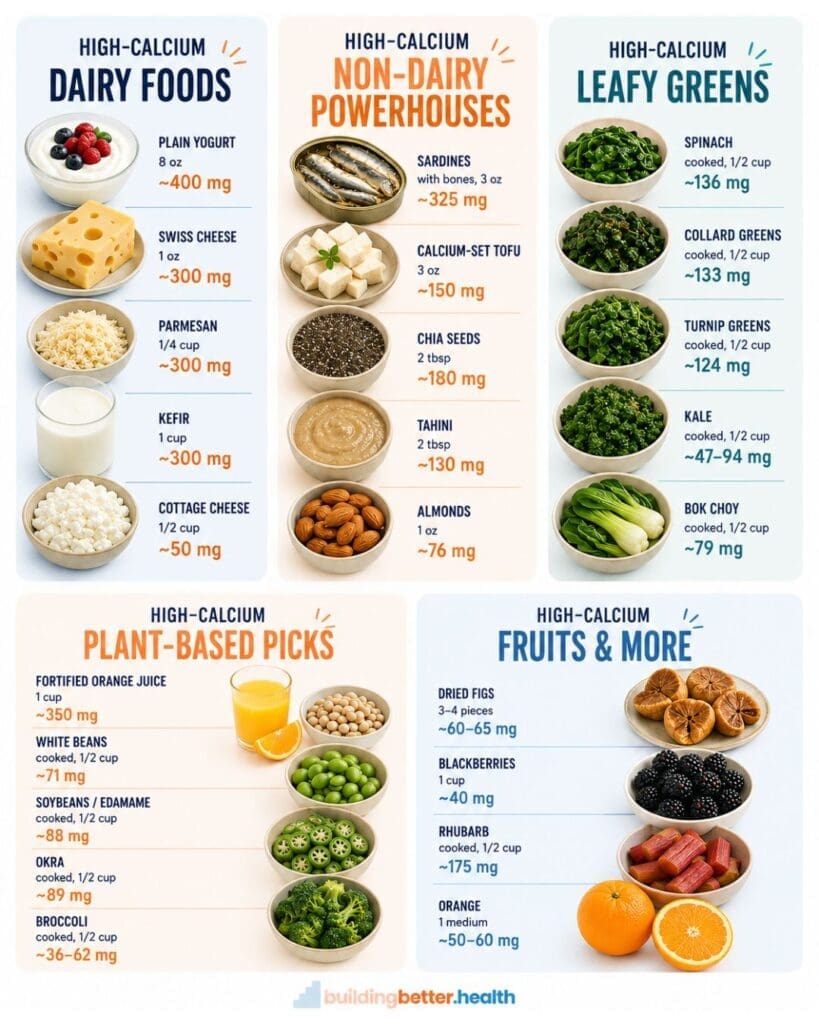
| Food | Serving | Calcium (mg) |
|---|---|---|
| Plain yogurt | 8 oz | ~400 mg |
| Swiss or Gruyère cheese | 1 oz | ~300 mg |
| Parmesan cheese | 1/4 cup grated | ~300 mg |
| Part-skim ricotta | 1/4 cup | ~300 mg |
| Kefir | 1 cup | ~300 mg |
| Cheddar cheese | 1 oz | ~200 mg |
| Cottage cheese | 1/2 cup | ~50 mg |
Worth knowing: cottage cheese has a reputation as a calcium powerhouse thanks to its protein content, but it’s actually one of the weaker cheese sources on this list — Swiss and Parmesan do far more work per ounce.
What If I’m Avoiding Dairy Completely? Best Non-Dairy Calcium Sources
For anyone skipping dairy altogether, not just milk, these are the foods that pull the most weight.
| Food | Serving | Calcium (mg) |
|---|---|---|
| Calcium-fortified orange juice | 1 cup | ~350 mg |
| Sardines with bones, canned | 3 oz | ~325 mg |
| Canned salmon with bones | 3 oz | ~180 mg |
| Chia seeds | 1 oz (2 tbsp) | ~180 mg |
| Rhubarb, cooked | 1/2 cup | ~175 mg |
| Calcium-set tofu | 3 oz | ~150 mg |
| Spinach, cooked | 1/2 cup | ~136 mg |
| Collard greens, cooked | 1/2 cup | ~133 mg |
| Tahini (sesame paste) | 2 tbsp | ~130 mg |
| Turnip greens, cooked | 1/2 cup | ~124 mg |
| Okra, cooked | 1/2 cup | ~89 mg |
| Soybeans/edamame, cooked | 1/2 cup | ~88 mg |
| Bok choy, cooked | 1/2 cup | ~79 mg |
| Almonds | 1 oz (about 23 nuts) | ~76 mg |
| White beans, cooked | 1/2 cup | ~71 mg |
| Kale, cooked | 1/2 cup | ~47–94 mg |
| Broccoli, cooked | 1/2 cup | ~36–62 mg |
| Dried figs | 3–4 pieces | ~60–65 mg |
| Blackberries | 1 cup | ~40 mg |
| Orange | 1 medium | ~50–60 mg |
Values are approximate and vary by brand, ripeness, and preparation.
How Much Calcium Do I Actually Need Per Day?
- Adults 19–50: about 1,000 mg/day
- Women 51+ and men 71+: about 1,200 mg/day
- Teens 9–18: about 1,300 mg/day
A cup of yogurt plus an ounce of Swiss cheese already covers most of that — no milk required. Going fully dairy-free takes a bit more spreading out, but a cup of fortified orange juice, a serving of tofu, and a side of collard greens gets you nearly as close.
What Blocks Calcium Absorption?
- Low vitamin D — vitamin D helps the body absorb calcium, so a deficiency limits how much you actually use, regardless of intake
- Very high sodium or caffeine intake — both increase how much calcium is lost through urine
- Oxalates and phytates — compounds found in spinach and some beans that bind to calcium and reduce absorption from that same food (spinach’s calcium, for example, is poorly absorbed compared to collard greens)
- Excess alcohol — interferes with the body’s vitamin D processing, indirectly affecting calcium absorption
High Calcium Foods: Frequently Asked Questions
I don’t like milk but I’m fine with cheese and yogurt — do I still need to worry about calcium?
Probably not much. An ounce of Swiss cheese and a cup of yogurt together already cover close to 700 mg, which puts most adults well on their way to the daily target without milk ever entering the picture.
Is spinach a good calcium source?
Spinach contains calcium, but its oxalate content blocks much of it from being absorbed. Collard greens, turnip greens, and bok choy provide better-absorbed calcium per serving.
Do I need a calcium supplement if I avoid dairy?
Not necessarily — many people meet their needs through food alone. A supplement is worth discussing with a doctor if bloodwork shows a deficiency or your diet consistently falls short.
What’s the single best food on this list if I want the least effort?
Yogurt. At around 400 mg per 8 ounces, it covers nearly half a day’s target in one serving, and it works for breakfast, a snack, or a smoothie base.
Please note: This website contains affiliate links. As an Amazon Associate, we earn from qualifying purchases at no additional cost to you.