Please note: This website contains affiliate links. As an Amazon Associate, we earn from qualifying purchases at no additional cost to you.
Quick Answer: Common signs your diet may be running low on healthy fats include dry or flaky skin, brittle hair and nails, constant hunger even after eating, stalled weight loss, and worsening PMS or joint stiffness. These aren’t a formal diagnosis — they’re everyday clues — but they show up often in people who spent years eating low-fat out of habit rather than necessity.
Why I Started Paying Attention to This
Most of my adult life, fat was the villain on every food label. Low-fat this, fat-free that — I can still picture the packaging. Even after learning that the right fats are actually good for you, there’s still a small voice that hesitates before I drizzle olive oil on something or eat the yolk instead of just the egg white.
What I didn’t realize for a long time is that eating too little fat doesn’t always announce itself. It’s rarely a dramatic problem — it’s small, easy-to-dismiss stuff that quietly builds up. Here’s what to look for.
1. Your Skin Is Dry, Flaky, or Itchy No Matter How Much Lotion You Use
Fat is a building block of the skin’s outer barrier, the layer that keeps moisture in and irritants out. When healthy fat intake is consistently low, that barrier can weaken, and no amount of lotion fully compensates because the problem is happening from the inside.
2. Your Hair Feels Brittle or Is Thinning More Than Usual
Hair follicles rely on fat and fat-soluble nutrients to stay strong. Persistent low-fat eating has been linked to hair that feels drier, more brittle, or sheds more than normal — especially if it’s a change you’ve noticed over months, not just a bad hair week.
3. You’re Starving Again an Hour After Eating
Fat slows digestion, which is a big part of what keeps a meal satisfying. A plate that’s heavy on carbs and protein but has almost no fat on it tends to leave you hungry again fast, even if the calorie count looks reasonable on paper.
4. Your Weight Loss Has Stalled Despite Doing Everything “Right”
This one surprises people. Fat plays a role in producing hormones that regulate metabolism and appetite, including estrogen and testosterone. Cutting fat too aggressively in the name of weight loss can backfire — it doesn’t just fail to speed things up, it can stall progress by disrupting the hormonal signals your body uses to regulate weight in the first place.
5. Your Joints Feel Stiffer or Achier Than They Used To
Omega-3 fats in particular play a role in regulating inflammation throughout the body. Low intake doesn’t cause joint pain on its own, but for people already dealing with mild stiffness or inflammation, insufficient omega-3s can be one factor making it harder to manage.
6. Your Periods Are Irregular, or PMS Has Gotten Noticeably Worse
Because fat is a precursor for hormone production, chronically low intake can show up as cycle irregularity or more intense PMS symptoms. This is one of the clearer signs that fat isn’t just a “nice to have” macronutrient — it’s structurally involved in hormonal health.
7. You’ve Got Small, Rough Bumps on the Backs of Your Arms
This texture — often mistaken for just “bumpy skin” — is sometimes tied to low essential fatty acid intake. It’s not the only cause, but it’s common enough in fat-deficiency research that it’s worth paying attention to if it shows up alongside some of these other signs.
8. You’re More Forgetful or Foggy Than Usual
About 60% of the brain is made up of fat, and omega-3s specifically are tied to cognitive function. Persistent low intake has been associated with brain fog and slower recall in some people, though this is also affected by sleep, stress, and plenty of other factors — fat is one piece, not the whole picture.
9. Your Nails Are Brittle or Slow to Grow
Like hair, nails depend on fat-soluble nutrients and healthy fat intake to grow at a normal rate and stay strong. Nails that split, peel, or grow noticeably slower than they used to can be one of the more visible day-to-day signs.
10. Your Eyes Feel Dry, or Your Night Vision Seems Worse
DHA, an omega-3 fatty acid, is a structural part of the retina. Low omega-3 intake has been associated with dry eyes and, in more pronounced cases, changes in night vision — another sign that’s easy to write off as “just getting older” when diet may be playing a role.
What Should I Do If Several of These Sound Familiar?
If a handful of these are hitting close to home, it’s worth looking at how much healthy fat you’re actually eating day to day — most people underestimate it after years of low-fat habits. I put together a full breakdown of how much fat you need and how to build it into meals, including how to pair it with protein for better absorption, in the companion article: How Much Healthy Fat Do I Actually Need Each Day?
None of these signs are a substitute for an actual diagnosis, though. If something feels persistent or severe — especially joint pain, cycle changes, or vision changes — it’s worth bringing up with a doctor rather than assuming it’s diet alone.
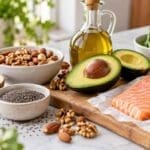
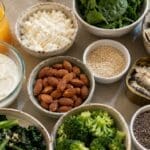
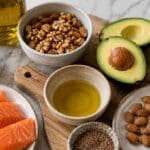
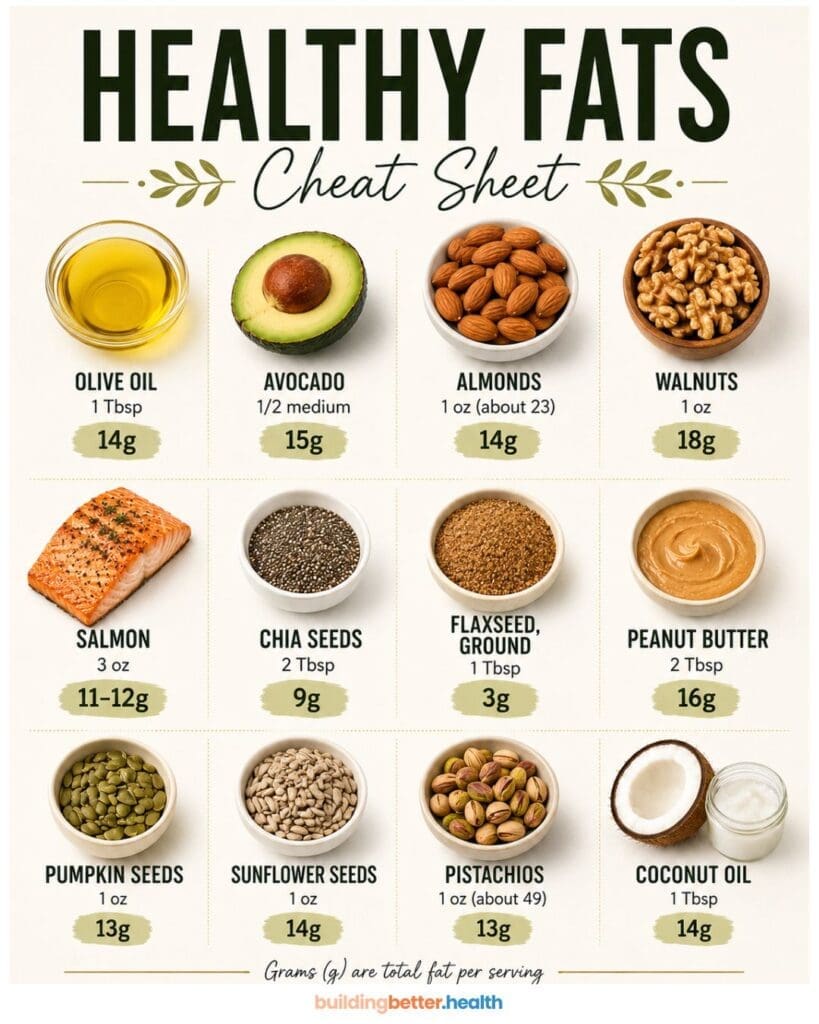
Easy Healthy Fats to Add to Your Diet
You don’t need to overhaul your grocery list or suddenly start putting chia seeds on everything you own.
Some of the best good fats to eat are ordinary foods that are easy to work into meals you already enjoy.
| Healthy Fat | Easy Way to Add It |
|---|---|
| Avocado | Add a few slices to eggs, toast or a wrap |
| Olive oil | Drizzle a little over vegetables or salad |
| Walnuts | Sprinkle over oatmeal or Greek yogurt |
| Chia seeds | Stir into yogurt, oatmeal or smoothies |
| Ground flaxseed | Add to oatmeal or a smoothie |
| Nut butter | Pair with fruit or add to a smoothie |
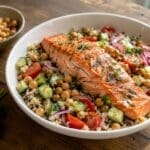
| Salmon | Get protein and healthy fats in one meal |
| Eggs | Easy for breakfast, lunch or a quick dinner |
You don’t need all eight. You don’t even need several of them at every meal.
The goal is simply to make sure healthy fats haven’t disappeared from your diet altogether.
We’ll take a deeper look at the best omega-3 foods and omega-3-rich foods in a separate article.
When Should You Talk to Your Doctor?
If you’ve simply realized you haven’t eaten a walnut since 2019, there’s no need to panic.
But persistent or significant symptoms—particularly unexplained skin changes, ongoing rashes, substantial hair loss, weakness, unexplained weight loss or digestive problems that may interfere with nutrient absorption—are worth discussing with a healthcare professional.
The important thing is not to diagnose yourself based on one symptom.
Dry skin can have many causes. So can fatigue. So can hair loss.
If something has noticeably changed or isn’t getting better, finding out what’s actually causing it is much more
Frequently Asked Questions
How long does it take to notice a difference after adding more healthy fat to my diet?
Some signs, like hunger and satiety, can improve within days. Skin, hair, and nail changes tend to take several weeks to a couple of months, since those tissues grow and turn over more slowly.
Could these signs mean something else besides low fat intake?
Yes. Dry skin, brittle hair, fatigue, and irregular cycles can all have other causes, from thyroid issues to simple dehydration. These are worth noticing as a pattern, not diagnosing on their own.
Could these signs mean something else besides low fat intake?
Not usually. True essential fatty acid deficiency is rare and typically shows up with bloodwork only in cases of severe restriction or malabsorption. For most people, these everyday signs combined with an honest look at your diet are enough to know it’s worth eating more healthy fat.
Do I need a blood test to know if I’m actually low on healthy fats?
Not usually. True essential fatty acid deficiency is rare and typically shows up with bloodwork only in cases of severe restriction or malabsorption. For most people, these everyday signs combined with an honest look at your diet are enough to know it’s worth eating more healthy fat.
Is it possible to have plenty of fat in my diet but still show these signs?
Yes, if most of it is coming from saturated or processed sources rather than the monounsaturated and polyunsaturated fats found in olive oil, nuts, seeds, and fatty fish. Quantity isn’t the only factor — the type of fat matters just as much.
Is dry skin a sign of omega-3 deficiency?
It can be. Rough, scaly skin is a recognized sign of omega-3 deficiency. However, ordinary dry skin is extremely common and has many possible causes, so dry skin alone doesn’t mean you’re deficient.
What is the most common sign you’re not getting enough healthy fats?
The best-documented signs of essential fatty acid deficiency involve the skin, including rough or scaly skin and dermatitis. However, these symptoms can have many other causes, and true essential fatty acid deficiency is rare in healthy adults.
Can not eating enough healthy fats make you tired?
Fatigue is often included on lists of low-fat or omega-3 deficiency symptoms, but it isn’t specific enough to diagnose a deficiency. If you’re eating considerably less food and experiencing ongoing fatigue, it’s worth looking at your overall nutrition and discussing persistent symptoms with your healthcare provider.
Can not eating enough fat cause hair loss?
Hair loss can occur in more severe essential fatty acid deficiency, but it also has many other potential causes. Hair loss by itself isn’t a reliable way to determine whether you’re eating enough fat.
What are some good healthy fats to eat?
Avocado, olive oil, nuts, seeds, nut butters, eggs and fatty fish such as salmon are all easy ways to include healthy fats in your diet.
Final Thoughts
If you suspect you’re not eating enough healthy fats, don’t start diagnosing yourself based on dry elbows or an afternoon energy slump.
Instead, look at your diet as a whole.
Are you regularly eating foods such as nuts, seeds, olive oil, avocado, eggs or fatty fish? Or has your diet become so focused on cutting calories and maximizing protein that fat has almost disappeared?
True essential fatty acid deficiency is rare, but that doesn’t mean healthy fats are optional. Your body needs essential fatty acids, and dietary fat also helps with things like absorbing vitamins A, D, E and K.
Sometimes the answer isn’t eating more food.
It’s making the food you’re already eating a little more balanced.
Sources
NIH Office of Dietary Supplements: Omega-3 Fatty Acids — Health Professional Fact Sheet
NIH Office of Dietary Supplements: Omega-3 Fatty Acids — Consumer Fact Sheet
Merck Manual: Essential Fatty Acid Deficiency
Please note: This website contains affiliate links. As an Amazon Associate, we earn from qualifying purchases at no additional cost to you.