Please note: This website contains affiliate links. As an Amazon Associate, we earn from qualifying purchases at no additional cost to you.
Everyone wants to talk about the expensive stuff.
The injections. The berberine. The fancy greens powders that cost $80 a month and taste like a freshly mowed lawn.
Meanwhile, sitting quietly on the bottom shelf of every pharmacy in America is a jar of plain psyllium husk that costs about ten dollars, lasts for months, and does something genuinely useful for weight loss — including for those of us on GLP-1 medications.
Nobody talks about it because nobody’s making money hyping it. There’s no influencer code for psyllium. It’s just… fiber. Humble, unglamorous, been-around-forever fiber.
So let me be the one to talk about it.
What Is Psyllium Husk, Exactly?
Psyllium husk comes from the seeds of a plant called Plantago ovata. If the name doesn’t ring a bell, the branded version will: it’s the main ingredient in Metamucil. But you can buy plain psyllium husk (or psyllium powder) for a fraction of the branded price, without the added sugar or artificial sweeteners some flavored versions include.
What makes psyllium special is that it’s a soluble, gel-forming fiber. When it hits water, it swells into a thick gel — and that gel is where all the weight loss benefits come from.
Think of it this way: most food moves through your stomach and empties fairly quickly. Psyllium’s gel slows that whole process down, which changes how full you feel, how fast sugar hits your bloodstream, and how much room is left for the snacking your brain keeps suggesting.
If any of that sounds familiar, it should.
Why Psyllium Is Interesting for GLP-1 Users (and the GLP-1-Curious)
Here’s the part that made me pay attention.
GLP-1 medications like Wegovy and Zepbound work partly by slowing down how quickly your stomach empties and by telling your brain you’re satisfied. Soluble fiber does a gentler, milder version of some of the same things — naturally.
When that fiber gel sits in your stomach and small intestine:
- You feel fuller, longer. The gel physically takes up space and slows stomach emptying, so a normal meal keeps you satisfied for more hours.
- Blood sugar rises more gently. Slower digestion means glucose trickles in instead of spiking — and fewer spikes means fewer crash-driven cravings a couple of hours after eating.
- Your body’s own satiety signals get support. Fermentable and gel-forming fibers are part of how the gut naturally signals fullness to the brain. It’s not a medication-level effect — not even close — but it’s the same direction of effect, from a jar that costs less than lunch.
That’s why I put psyllium in the “natural GLP-1 support” category: it’s one of the few cheap, boring, evidence-supported tools that nudges the same levers.
And if you’re already ON a GLP-1? Psyllium still earns its spot, for two reasons: it helps on the days before your next shot when appetite creeps back (my fellow Zepbound users know exactly which days I mean), and it directly addresses the side effect nobody warns you enough about — which brings me to the next point.
The Unglamorous Benefit: Let’s Talk About Constipation
I’ll keep this brief but honest, because it matters.
Constipation is one of the most common complaints on GLP-1 medications. When digestion slows down (which is literally what these medications do), things can get… stuck. And most of the standard advice — “eat more fiber!” — is easier said than done when your appetite is suppressed and you’re eating half of what you used to.
Psyllium solves the math problem. When you’re only eating 1,200–1,500 calories a day, getting 25–30 grams of fiber from food alone is genuinely difficult. A serving of psyllium adds meaningful fiber without adding meaningful calories or requiring you to eat a mixing bowl of broccoli you don’t have room for.
One critical caveat, and I mean critical: psyllium only works if you drink enough water with it — and it can make constipation worse if you don’t. The gel needs liquid to form and to move. Take psyllium with too little water and you’ve essentially added a paste to an already slow system.
Follow the package directions on liquid, and then drink more water throughout the day on top of that. (If you’re not sure whether you’re getting enough, here’s how to spot the signs of dehydration — they’re sneakier than you’d think.)
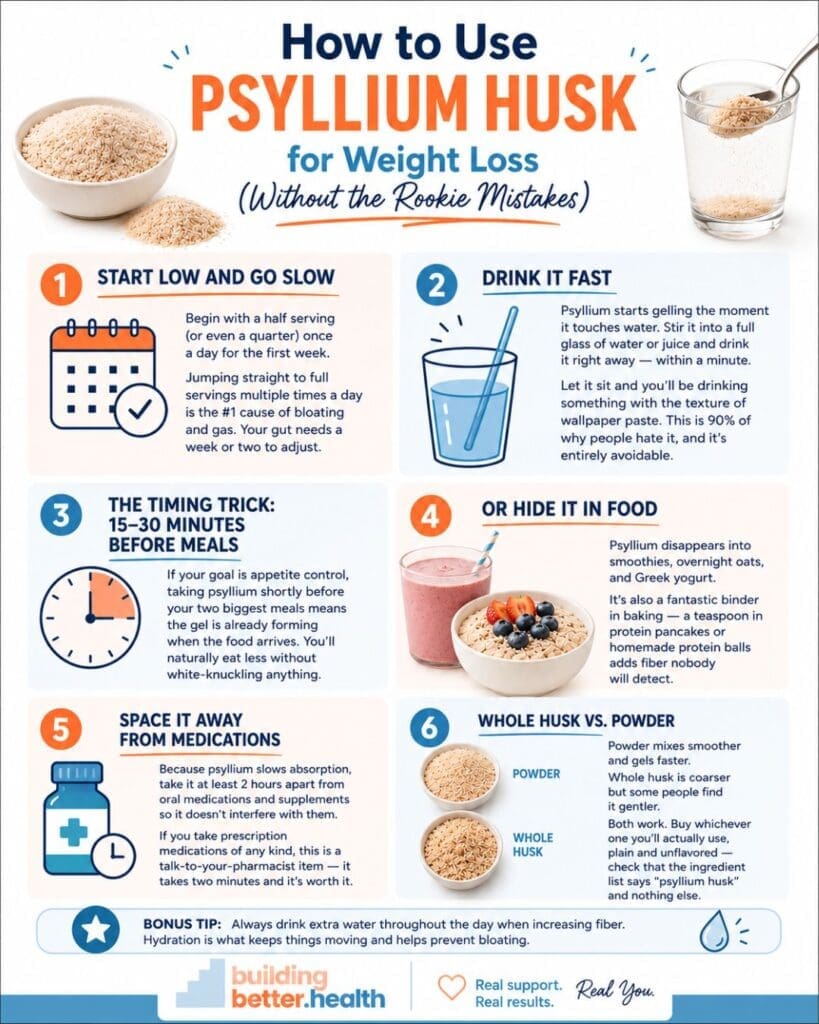
How to Actually Use Psyllium Husk (Without the Rookie Mistakes)
This is where most people go wrong, give up after three days, and tell everyone psyllium is disgusting. It doesn’t have to be. Here’s what I’ve learned:
- Start low and go slow. Begin with a half serving (or even a quarter) once a day for the first week. Jumping straight to full servings multiple times a day is the #1 cause of the bloating and gas complaints. Your gut needs a week or two to adjust to any fiber increase.
- Drink it fast. Psyllium starts gelling the moment it touches water. Stir it into a full glass of water or juice and drink it right away — within a minute. Let it sit and you’ll be drinking something with the texture of wallpaper paste. This is 90% of why people hate it, and it’s entirely avoidable.
- The timing trick: 15–30 minutes before meals. If your goal is appetite control, taking psyllium shortly before your two biggest meals means the gel is already forming when the food arrives. You’ll naturally eat less without white-knuckling anything.
- Or hide it in food. Psyllium disappears into smoothies, overnight oats, and Greek yogurt. It’s also a fantastic binder in baking — a teaspoon in protein pancakes or homemade protein balls adds fiber nobody will detect.
- Space it away from medications. Because psyllium slows absorption, take it at least 2 hours apart from oral medications and supplements so it doesn’t interfere with them. If you take prescription medications of any kind, this is a talk-to-your-pharmacist item — it takes two minutes and it’s worth it.
- Whole husk vs. powder: powder mixes smoother and gels faster; whole husk is coarser but some people find it gentler. Both work. Buy whichever one you’ll actually use, plain and unflavored — check that the ingredient list says “psyllium husk” and nothing else.
Which Psyllium Husk Should You Buy? (I’ve Tried Three of These)
You can find psyllium at any pharmacy or grocery store, but the selection is usually one dusty branded option at a markup. Amazon is where the good plain stuff lives — and I’ve personally worked my way through three of the most popular options, so here’s the honest breakdown:
BEST VALUE: NOW Foods Psyllium Husk Powder
At under a dollar per ounce, this is the cheapest way to find out if psyllium works for you. NOW is a reliable supplement brand (Non-GMO Project verified), the powder mixes fine, and there’s zero premium for fancy packaging. If you’re psyllium-curious and don’t want to overthink it, start here.
BEST ORGANIC: Anthony’s Organic Psyllium Husk Powder
USDA organic and noticeably finely ground — of the three I’ve used, this one disappears most smoothly into smoothies, yogurt, and baking. The sticker price looks higher, but that’s a 1.5-pound bag; per ounce it’s barely more than the budget pick, and it lasts ages. This is the one I reach for most.
See reviews and pricing on Amazon
BEST FOR GLP-1 USERS: It’s Just! Psyllium Husk Powder
One ingredient, third-party tested, easy mixing, and — fittingly — it’s marketed specifically as GLP-1 friendly. It costs a bit more per ounce than the other two, but it’s earned its bestseller status: it mixes quickly without clumping, which matters when the rule is “drink it before it gels.” If you’re on Wegovy or Zepbound and want the option designed with you in mind, this is it.
WHOLE HUSK OPTION: Organic India Whole Psyllium Husk
Full transparency: I haven’t tried this one personally — I’m a powder person. But if you prefer whole husk (the intact, flakier form some people find gentler on digestion), this is the most popular organic option, and it’s the same plant, same fiber, same benefits. Whole husk gels a little more slowly than powder, which some people actually prefer for texture.
View pricing and reviews on Amazon
Whichever you Psyllium brand choose, apply the same one-second label check: the ingredient list should say psyllium husk and nothing else. No sweeteners, no flavors, no “proprietary blend.”
What Psyllium Won’t Do
Let’s keep it honest, because this website doesn’t do miracle framing.
Psyllium husk will not melt fat, replace a medication, or out-fiber a diet of takeout. The research on psyllium and weight shows modest effects — better appetite control, better blood sugar response, improved cholesterol numbers, more regular digestion — that support weight loss rather than cause it. It’s a supporting actor, not the star.
But here’s the thing about supporting actors: at $10 for a multi-month supply, psyllium doesn’t need to be the star. It needs to make everything else you’re doing — the protein-first eating, the overall fiber intake, the medication if you’re on one — work a little better. And that it does.
I keep it on my GLP-1 shopping list for exactly that reason.
FAQ: Psyllium Husk and Weight Loss
How much psyllium husk should I take for weight loss?
Most research on appetite and blood sugar uses roughly 5–10 grams per day, split before meals — but start with far less and build up over a week or two. Follow your product’s label, take it with a full glass of liquid, and check with your doctor or pharmacist if you take any medications or have any digestive conditions.
When should I take psyllium — morning or night?
For appetite control, 15–30 minutes before your largest meals works best. For regularity, consistency matters more than timing — same time every day. Avoid taking it right before bed with too little water.
Can I take psyllium husk on Wegovy or Zepbound?
Many GLP-1 users take psyllium to help with fiber intake and constipation, but because both the medication and the fiber slow digestion, start extra slowly, prioritize water, and clear it with your prescriber first — especially if you’re managing side effects like nausea or reflux.
Is Metamucil the same as psyllium husk?
Metamucil’s active ingredient is psyllium, but flavored versions add sweeteners and cost several times more per serving. Plain psyllium husk or powder gives you the same fiber for a fraction of the price.
Does psyllium husk reduce food noise?
It’s no medication, but the fuller-longer effect and steadier blood sugar genuinely quiet the “what’s in the pantry” chatter for many people — especially the crash-driven cravings that hit a couple hours after a carb-heavy meal.
How much fiber is actually in psyllium husk?
A typical serving (about 1 tablespoon, or 5 grams) delivers roughly 4 grams of fiber — nearly all of it the soluble, gel-forming kind. For context, adults generally need 25–38 grams of fiber daily, and most Americans get about half that. So one or two servings of psyllium won’t cover your full requirement, but it can close a meaningful chunk of the gap — especially on a GLP-1, when smaller portions make hitting fiber targets from food alone genuinely difficult.
The Bottom Line
In a space full of $1,000-a-month medications and $80 supplement subscriptions, there’s something almost funny about a $10 jar of plant husks quietly doing real work: fuller meals, steadier blood sugar, better digestion, and a gentle nudge to the same satiety systems everyone’s paying so much to activate.
It’s not magic. It’s just fiber.
But it might be the highest-return ten dollars in the entire weight loss aisle.
This article is for informational purposes only and is not medical advice. Psyllium can interact with medications and isn’t right for everyone — talk to your doctor or pharmacist before adding any supplement, especially if you take prescription medications, are on a GLP-1, or have any digestive or swallowing conditions. Always take psyllium with adequate liquid.
Please note: This website contains affiliate links. As an Amazon Associate, we earn from qualifying purchases at no additional cost to you.