

Please note: This website contains affiliate links. As an Amazon Associate, we earn from qualifying purchases at no additional cost to you.
QUICK ANSWER: Yes! As of July 1, 2026, Medicare covers Zepbound for weight loss through a temporary program called the Medicare GLP-1 Bridge. If you have a Medicare Part D drug plan and qualify, you pay a flat $50 per month at any dose, with coverage running through December 31, 2027. But only the Zepbound KwikPen is covered, there are health requirements to meet, and no one knows yet what happens after the program ends.
Here’s What You Need to Know…
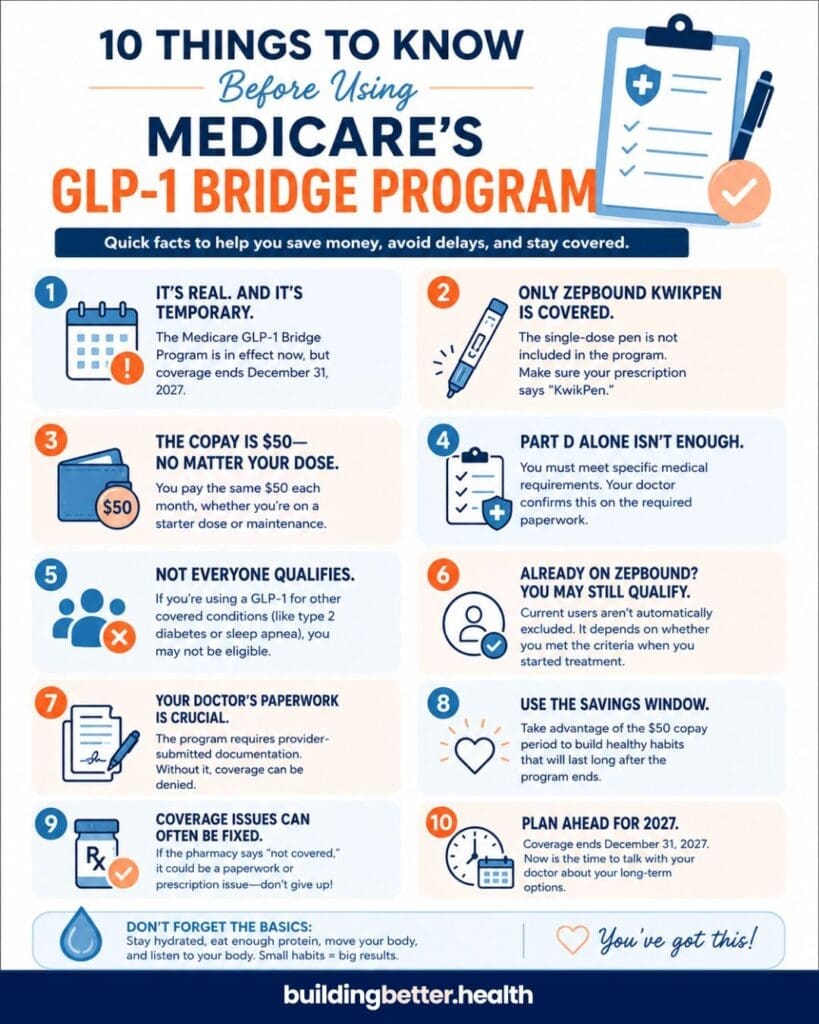
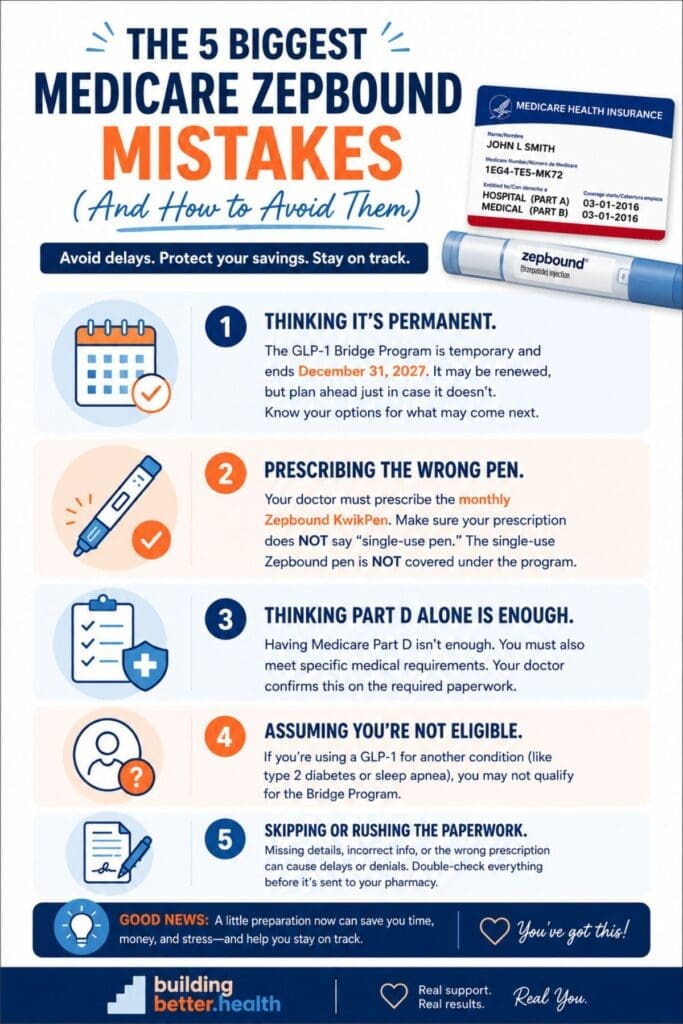
- Medicare now covers Zepbound for qualifying beneficiaries through the Medicare GLP-1 Bridge Program, with eligible patients paying no more than $50 per month.
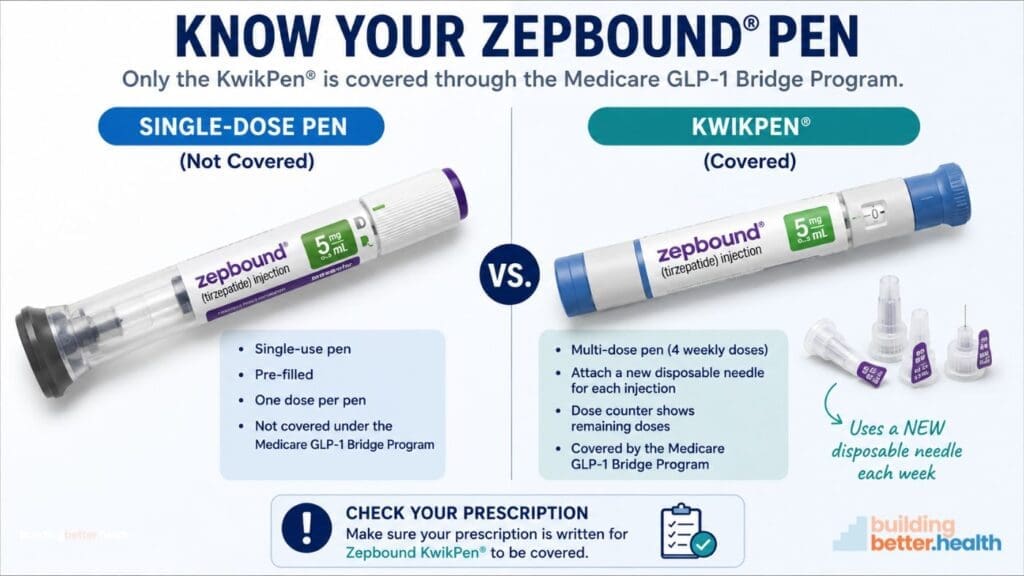
- Only the monthly Zepbound KwikPen qualifies. If your prescription is written for the single-use pen, it may not be eligible under the program.
- Medicare Part D alone isn’t enough. Your doctor must confirm you meet the medical eligibility requirements and submit the required paperwork.
- Current Zepbound users may still qualify. Eligibility depends on your medical history and when you started treatment—not simply whether you’re already taking the medication.
- If your pharmacy says you’re not covered, don’t assume you’re ineligible. Many coverage problems are caused by paperwork or prescription errors that can often be corrected.
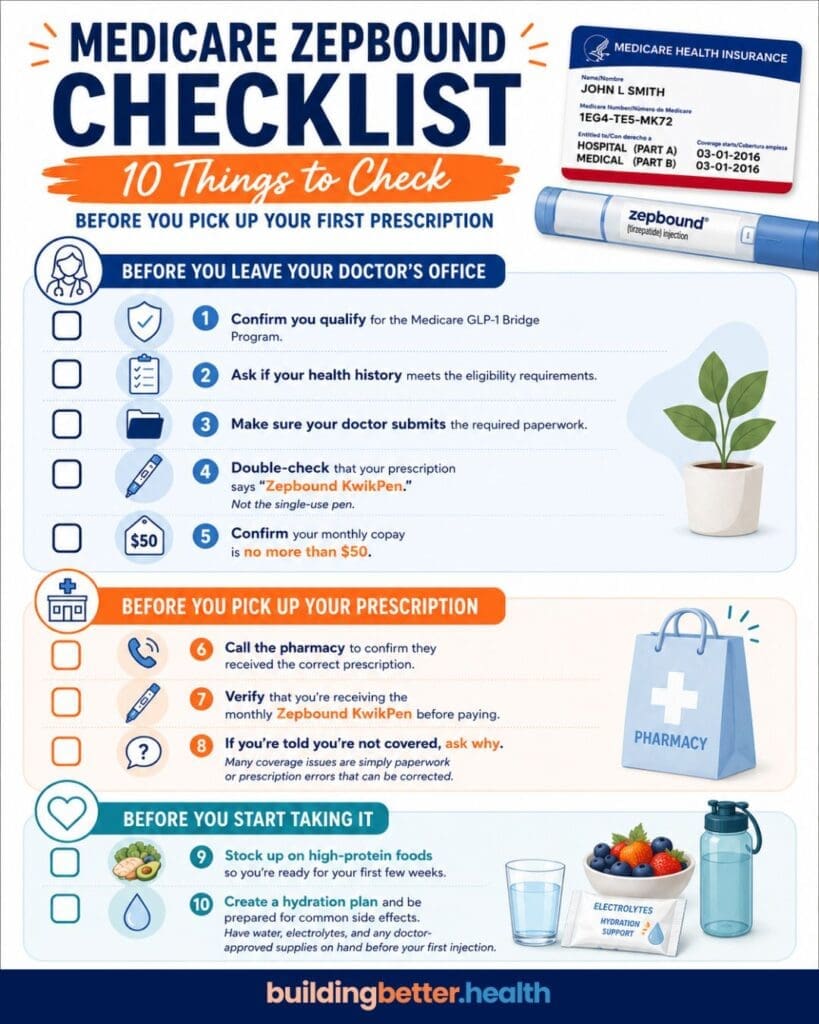
- Before leaving your doctor’s office, verify three things: your paperwork has been submitted, your prescription is written for the Zepbound KwikPen, and your expected copay is no more than $50.
If you’ve been waiting for Medicare to cover weight loss medication — or paying cash prices that made your eyes water — this is the news you’ve been hoping for.
Sort of. As someone who takes Zepbound myself, I’ve read through the fine print so you don’t have to, because the headlines are leaving out some things that really matter.
Let’s walk through what this program actually is, who gets it, and the questions you should be asking before you call your doctor.
What Is the Medicare GLP-1 Bridge?
The Medicare GLP-1 Bridge is a temporary program — a trial run — created by the government agency that runs Medicare. It started July 1, 2026 and lasts through December 31, 2027, and it’s the first time Medicare has ever paid for these medications when they’re prescribed just for weight loss. (CMS: Medicare GLP-1 Bridge)
Here’s the good news about how it’s set up: you don’t need a special Medicare plan. If you have any Medicare Part D drug plan and you qualify, you’re in. Your plan doesn’t have to sign up for anything, and you don’t have to switch plans. (CBS News)
And here’s the catch: this is not a permanent benefit. It’s a trial, and it has an end date. I’ll explain exactly what that means for you a little further down — it’s the most important part of this whole article.
Which Medications Are Covered?
The Bridge program covers exactly three medications for weight loss:
- Zepbound KwikPen (tirzepatide) — the weekly multi-dose injection pen
- Wegovy (semaglutide) — both the injection and the pill
- Foundayo — Eli Lilly’s daily weight-loss pill
That’s it. And within Zepbound, there’s a catch big enough that it deserves its own section.
The KwikPen Catch (Read This Before You Get Excited)
Only the Zepbound KwikPen — the multi-dose pen — is covered under the Bridge program. The single-dose pens and single-dose vials are not covered. (CNN)
Why does this matter? If you’ve been on Zepbound with commercial insurance, you’re probably used to the single-dose pens — the disposable ones where each pen is one weekly shot. The KwikPen is different: it’s a multi-dose pen that holds four weekly doses, and you attach a fresh needle and dial your dose each week.
I’ll be honest: the KwikPen has a slightly bigger learning curve. I use the regular single-use pen but I’ve watched someone firsthand inject with the KwikPen. It’s not hard, but it’s not the “uncap, click, done” experience of the single-dose pen. Your pharmacist can walk you through it the first time, and after a week or two it becomes routine.
Just know going in that if your doctor’s office or pharmacy tries to fill the single-dose version, it won’t be covered — make sure the prescription specifies the KwikPen.
Who Qualifies for the $50 Copay?
Two things need to be true:
- You’re enrolled in a Medicare Part D drug plan (any one — no special plan needed).
- Your doctor confirms you meet the health requirements by filling out a form for Medicare. This is called “prior authorization” — it just means your doctor’s office sends in paperwork before the pharmacy can fill your prescription. You don’t fill anything out yourself.
The health requirements are based on your BMI (a number your doctor calculates from your height and weight) plus your health history. According to CBS News, you qualify if you have:
- A BMI of 30 or higher plus a history of heart failure, uncontrolled high blood pressure, or chronic kidney disease, or
- A BMI of 27 or higher plus prediabetes, a previous heart attack or stroke, or poor circulation in your legs (peripheral artery disease)
There are other qualifying combinations too, so if you’re close to these numbers, don’t rule yourself out — ask your doctor. Roughly 3.8 million people on Medicare are expected to qualify. (CBS News)
The Eligibility Trap Nobody’s Talking About
Here’s the gotcha that’s already catching people: if you already have a GLP-1 prescription under Medicare Part D for another condition — like Type 2 diabetes or sleep apnea — you are not eligible for the Bridge program.
CNN reported on a woman who was prescribed Zepbound for sleep apnea last year, never even filled it because of the cost, and still likely won’t qualify.
If this is your situation, don’t give up entirely — talk to your doctor about your options. But go into that conversation knowing this restriction exists, so you’re not blindsided at the pharmacy counter.
Already on a GLP-1? Here’s the Good News
If you’re already taking Zepbound or Wegovy and paying for it yourself, you may still qualify — and there’s a detail here that will be a real relief.
What matters is your health situation WHEN you first started the medication — not today. Your doctor simply confirms on the form that you met the requirements back when you began. So if you started two years ago with a BMI of 37, and the medication has worked and you’re now at 32? You still qualify. (NPR)
This is exactly the right design, in my opinion. Punishing people because the medication worked would have been cruel — and I know it’s a question a lot of long-term users were worried about.
What Does $50 a Month Actually Get You?
The copay is a flat $50 per month, at any dose. Whether you’re on the 2.5mg starter dose or the 15mg maintenance dose, it’s $50. That’s meaningfully different from typical insurance, where higher doses often cost more — and most people do need higher doses to maintain their weight loss over time. (NPR)
For comparison, cash prices for the Zepbound KwikPen through LillyDirect run roughly $299 to $449 per month depending on dose. So the Bridge program saves most people $250–$400 a month.
Two things to know about how the $50 works:
- You pay $50 starting with your very first fill. You do not have to meet your Part D deductible first.
- The $50 doesn’t count toward your other drug costs. Because this program runs separately from your regular drug plan, these payments won’t help you reach your deductible or your yearly spending cap on other medications. Think of it as its own separate bill.
How Long Will Medicare Cover This? (Please Read This Part)
This is the most important thing to understand about this program, so I’m going to say it as plainly as I can.
This coverage has an end date: December 31, 2027.
That’s it. That’s the whole thing to remember. Whether you start the medication today or six months from now, Medicare will pay for it — at $50 a month — through the end of 2027. This is not a permanent benefit. It’s a trial program the government is running to see how it goes.
What happens on January 1, 2028? Honestly? Nobody knows yet — not me, not your doctor, not your pharmacist. The government was working on a permanent plan to take over after this trial, but it fell through. (Healthline) They may create a new one. They may extend this one. Or the coverage may simply end, and you’d be back to paying full price — which currently runs $299 to $449 a month for the covered Zepbound pen.
So before you start, ask yourself one question: “If Medicare stops paying in 2028, what’s my plan?” Maybe the answer is “I’ll pay out of pocket if I have to.” Maybe it’s “I’ll use this time to lose the weight and build habits that help me keep it off.”
Both are reasonable — but you want to walk in with your eyes open, not find out at the pharmacy counter in January 2028.
And if you do start, making your time on the medication count — building the eating habits, protein strategy, and routines that protect your results — matters more than ever.
How to Actually Get Started
- Talk to your doctor. Ask directly: “Do I qualify for the Medicare GLP-1 Bridge program?” They’ll check your health history against the requirements — including the existing-prescription rule above.
- Your doctor’s office sends in the paperwork. They submit the prior authorization form to Medicare. You don’t have to do anything for this step. (Your doctor doesn’t even need to be a Medicare-enrolled provider to do it.)
- Double-check the prescription says “Zepbound KwikPen.” This is worth saying out loud at the appointment. If the prescription is written for the single-dose pens or vials, the pharmacy can’t bill it through the program.
- Fill it at the pharmacy and pay your $50.
If the pharmacy says you were denied, don’t panic — call your doctor’s office and ask why. It’s often a paperwork problem that can be fixed and resubmitted.
What to Read Next:
Once you’re approved for your medication, we’ve created some simple guides that will help you minimize side effects, find food that’s easy on your stomach, as well as other tips.
- Starting a GLP-1 After Age 65: What’s Different and How to Set Yourself Up to Succeed
- GLP-1 Side Effects for Users Over 65 (what to expect and how to minimize them!)
- Your First Month on GLP-1 – What to Eat
- Protecting Your Muscle on a GLP-1 After 65: The Complete Guide
Frequently Asked Questions
Is this the same as Medicare “approving” Zepbound permanently?
No. It’s a temporary pilot program through December 31, 2027. Medicare law itself hasn’t changed.
Does this apply to Medicaid too?
This particular program is Medicare-only. Separately, states have the ability to expand Medicaid access to Zepbound under Eli Lilly’s agreement with the federal government (Lilly press release), but that varies by state — check with your state Medicaid office.
Can I get Wegovy instead of Zepbound under this program?
Yes — Wegovy is covered in both injection and pill form, and it’s a conversation to have with your doctor about which medication fits you.
What if I’m on Zepbound for sleep apnea?
If your existing GLP-1 prescription is under Part D for sleep apnea or diabetes, you’re not eligible for the Bridge program. Talk to your doctor about your coverage options.
Do I need a special Part D plan?
No. Any Medicare Part D drug plan works. The program runs separately from your plan, so there’s nothing to switch and nothing your plan has to do.
Will the price go up at higher doses?
No — the $50 copay is flat at every dose, which is one of the best features of the program.
Sources: CMS — Medicare GLP-1 Bridge · CBS News · NPR · CNN · Healthline · Eli Lilly
This article is for informational purposes only and is not medical or insurance advice. Always confirm coverage details with Medicare and talk to your healthcare provider about whether a GLP-1 medication is right for you.
Please note: This website contains affiliate links. As an Amazon Associate, we earn from qualifying purchases at no additional cost to you.