


Please note: This website contains affiliate links. As an Amazon Associate, we earn from qualifying purchases at no additional cost to you.
Is Your GLP-1 Dose Still Working? Here’s How to Tell
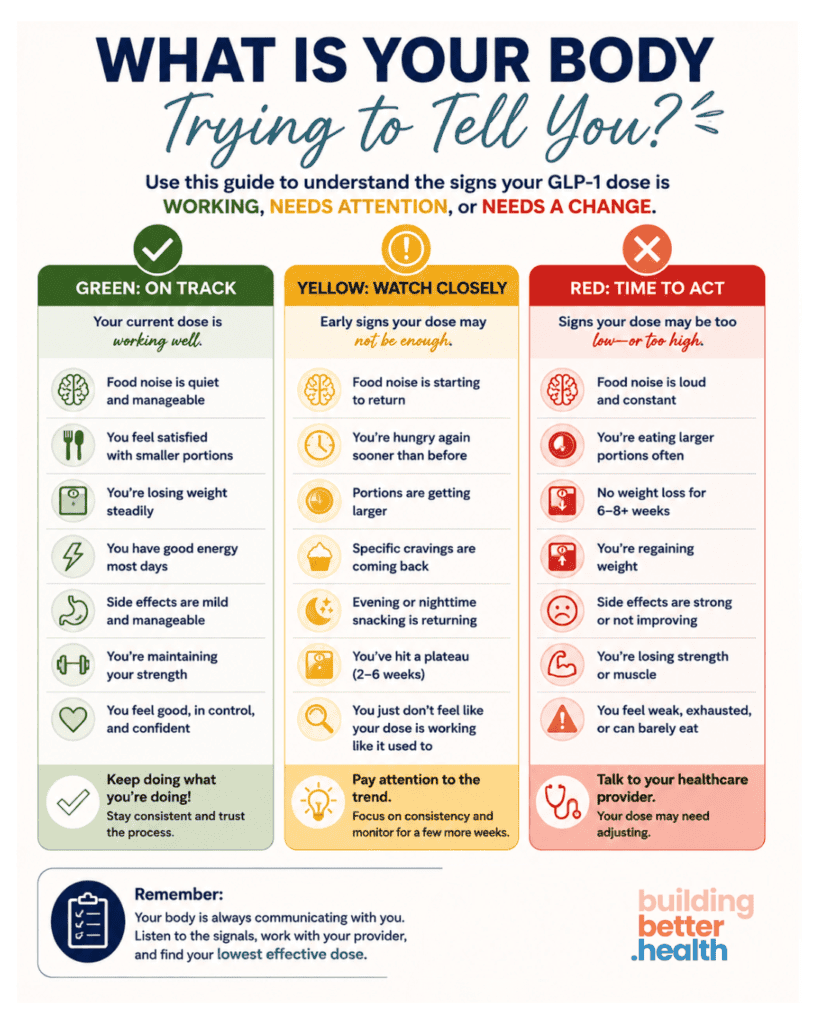
Quick Answer: Signs your GLP-1 dose may be too low include returning food noise, feeling hungry earlier, eating larger portions, and no weight loss for six to eight weeks despite consistent habits. Signs your dose may be too high include losing weight too quickly, barely being able to eat, side effects that never improve, and losing strength along with weight. Before assuming your dose is the problem, rule out dehydration, low protein intake, and unrealistic comparisons to others. Always discuss dose changes with your healthcare provider.
When I first started taking a GLP-1 medication, I assumed my goal was simple: keep increasing the dose until I reached the highest one available.
After all, that’s what the dosing schedule seemed to suggest. But over time, I realized something that completely changed the way I look at these medications.
Increasing the dose doesn’t necessarily mean increasing the weight loss. It usually means increasing the side effects.
That doesn’t mean higher doses are bad. For many people, increasing the dose is exactly what helps them continue losing weight. But I also think many people feel pressured to move up simply because the calendar says it’s time, even when their current dose is still working beautifully.
Personally, I’ve taken a different approach. After switching to Zepbound, I’ve remained on 5 mg for nearly a year.
Could I have increased sooner? Absolutely. But my appetite was still under control, the constant food thoughts were quiet, I was continuing to lose weight, and perhaps most importantly, my side effects were minimal. For me, staying on the lowest dose that continued to work made far more sense than rushing to a higher one.
Only recently have I started preparing to move to 7.5 mg, not because my calendar told me to, but because my body finally started giving me signs that it might be time.
That’s really the philosophy behind this article.
Instead of asking, “When am I supposed to increase my dose?“, I think a better question is:
“Is my current dose still doing its job?”
If the answer is yes, there may not be any reason to increase it.
First, a Quick Look at How GLP-1 Dosing Schedules Work
Before we get into the signs, it helps to understand what the “standard” schedule actually looks like — because knowing the schedule is what makes it easier to recognize when your body is (or isn’t) following it.
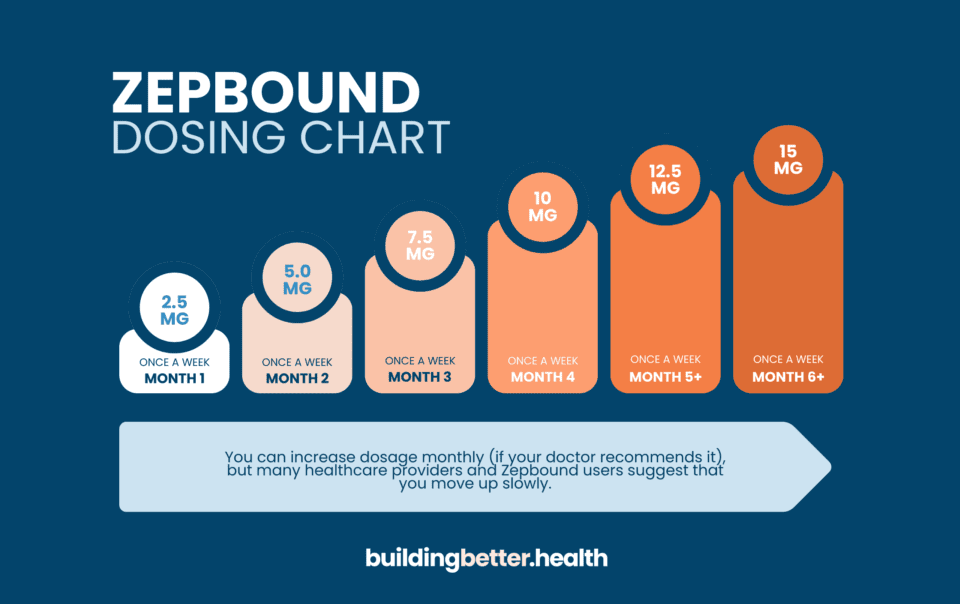
Every GLP-1 medication uses gradual dose escalation. You start at the lowest dose, stay there for at least four weeks so your body can adjust, and then your provider decides whether to move you up. For Zepbound and Mounjaro (tirzepatide), the steps are 2.5 mg → 5 mg → 7.5 mg → 10 mg → 12.5 mg → 15 mg. Wegovy (semaglutide) follows a similar stair-step pattern up to 2.4 mg.
Here’s the part that gets lost: that schedule is a roadmap, not a mandate. The starting dose exists purely to help your body acclimate — but once you reach an effective dose, there is no rule that says you must keep climbing. Plenty of people maintain excellent results at 5 mg, 7.5 mg, or 10 mg and never touch the maximum dose.
If you want the full breakdown of the schedule, injection tips, and what to expect at each level, I cover it all in my Wegovy dosing and Zepbound dosing and injection schedule.
Now — the signs.
Signs Your GLP-1 Dose May Be Too Low
1. Your Food Noise Has Returned
For many people, one of the first things they notice after starting a GLP-1 medication is something they didn’t even realize had a name: food noise.
Food noise is that constant mental chatter about food. It’s thinking about lunch while you’re eating breakfast. It’s walking past the pantry for the tenth time hoping something suddenly sounds good. It’s negotiating with yourself over whether you “deserve” dessert.
When your medication is working well, that noise often becomes remarkably quiet.
If you notice those constant thoughts slowly creeping back into your daily life, it may be one of the earliest signs that your current dose isn’t providing the same level of appetite control it once did.
One important exception: if the food noise only shows up in the day or two before your next injection, that’s a normal part of the weekly medication cycle — not a sign your dose has stopped working. I wrote about exactly that pattern (and how I handle it) in my 48-hour reset for food noise before shot day.
2. You’re Hungry Again Much Earlier Than You Used to Be
There’s nothing wrong with feeling hungry. In fact, healthy hunger is normal. The difference is whether your hunger feels similar to how it did before starting your medication.
If you find yourself eating a meal and feeling genuinely hungry again an hour later, or you’re counting down the minutes until your next snack, it’s worth paying attention.
Many people notice this change gradually. Portions become a little larger. Snacking becomes more frequent. Appetite slowly increases without them even realizing it.
One day they suddenly think, “Wait a minute…I don’t think this medication is working like it used to.”
That doesn’t automatically mean you need a higher dose, but it is something worth discussing with your healthcare provider.
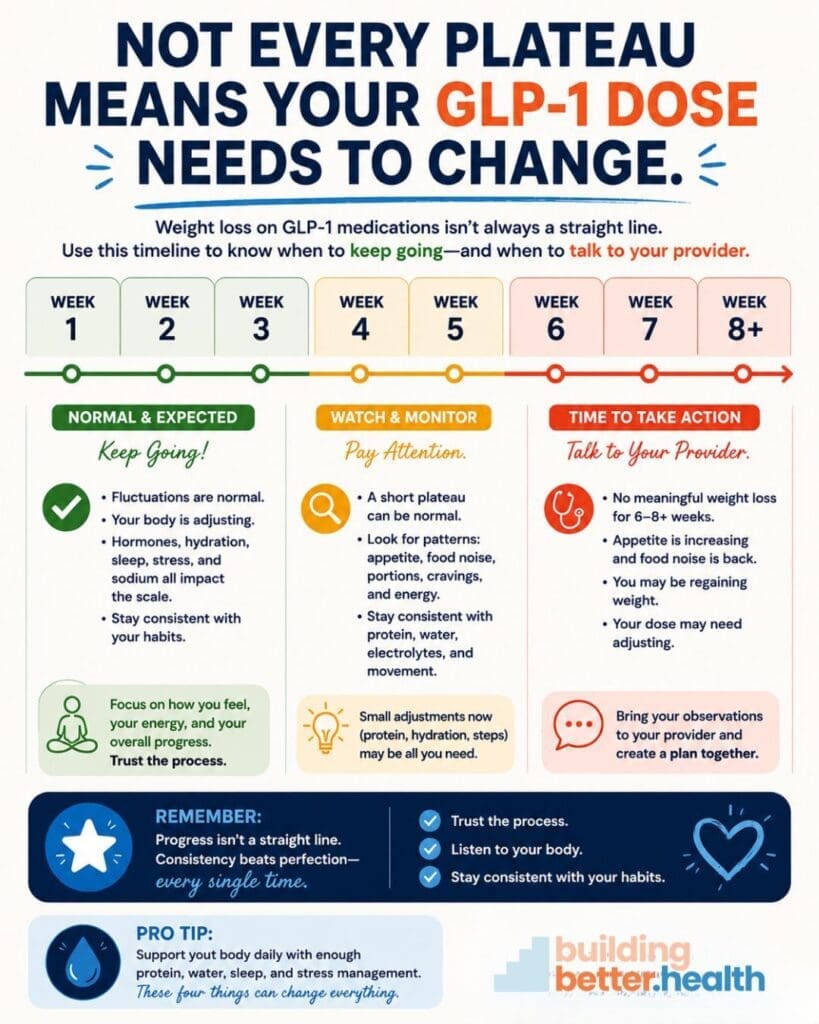
3. You Haven’t Lost Weight in More Than Six to Eight Weeks
This is probably one of the most misunderstood parts of any weight-loss journey. A one-week plateau is normal. A two-week plateau is normal. Even three weeks without seeing the scale move can happen from time to time.
Our bodies aren’t designed to lose weight in a perfectly straight line. Hormones fluctuate. Water retention changes. Stress, sleep, sodium intake, and even the weather can affect the number on the scale.
One of the biggest mistakes I see people make is assuming that two weeks without weight loss means the medication has stopped working.
Usually, it hasn’t. (My friend’s 110-pound Wegovy journey is a perfect example of what “stopped working” usually really means.)
However, if you’ve gone six to eight weeks without any meaningful weight loss, you’re consistently following your eating plan, your appetite is increasing, and food noise is returning, that may be a reasonable time to talk with your healthcare provider about whether your dose should be adjusted.
The key word here is consistent. Before assuming your medication is the problem, make sure your nutrition, hydration, protein intake, and activity level have remained consistent as well. If they have, and the scale still won’t budge, here’s how to break through a weight loss plateau before you change anything about your medication.
4. You’re Eating Larger Portions Without Realizing It
One of the benefits of GLP-1 medications is that they naturally help you recognize fullness sooner.
You don’t have to rely on willpower because your body begins sending those “I’m satisfied” signals much earlier. If you start noticing that you’re finishing meals that used to last two sittings or you’re reaching for second helpings more often, it could be a sign that your appetite suppression is beginning to wear off.
This usually happens gradually, which is why it’s so easy to miss.
Sometimes looking back over the past month tells the story much better than looking at yesterday alone.
5. You’re Constantly Thinking About Your Next Meal
Many people describe GLP-1 medications as finally giving them a sense of peace around food.
Instead of constantly planning meals or battling cravings all day, food simply becomes…food.
If you find yourself once again thinking about what you’re going to eat next while you’re still eating your current meal, it’s worth paying attention. Food noise often returns before weight gain does, making it one of the earliest indicators that something may be changing.
6. Your Old Cravings Are Coming Back
This one is different from general food noise, and it’s worth its own spotlight.
Food noise is background chatter. Cravings are targeted. Maybe it’s the drive-thru you used to hit three times a week. Maybe it’s the specific candy you kept in your desk drawer, or the late-night bowl of cereal that used to feel non-negotiable.
For most people, GLP-1 medications don’t just quiet hunger — they seem to turn down the volume on those very specific, very personal cravings. Many people are shocked to discover that the foods they once felt powerless around simply don’t call to them anymore.
So if your old favorites are starting to whisper again — if you’re suddenly thinking about that food at that time of day, just like you used to — pay attention. The return of your personal “trigger foods” is often one of the clearest signs that your dose isn’t providing the same level of support it once did.
7. Evening and Nighttime Eating Is Creeping Back In
For a lot of us, the hardest hours were never at breakfast. They were between dinner and bedtime.
One of the most life-changing effects of a GLP-1 medication is how quiet those evening hours become. Dinner ends, and…that’s it. No standing in front of the open refrigerator at 9 p.m. No “just one more snack” before bed.
If you’ve noticed that pattern returning — wandering back into the kitchen after dinner, snacking during your evening shows, or waking up and thinking about food — it’s worth tracking for a week or two.
Evening eating tends to return before daytime appetite does, which makes it a surprisingly reliable early-warning signal.
8. You’ve Started Regaining Weight
A plateau is one thing. Regain is another.
If the scale has been slowly trending upward for several weeks — not a one-day bounce from sodium or hormones, but a genuine pattern — and your habits haven’t meaningfully changed, that’s one of the clearest signs that your current dose may no longer be enough.
Don’t panic, and don’t assume the medication has “failed.” A small regain doesn’t erase your progress, and it doesn’t mean you’re back at square one. It simply means it’s time for a conversation with your healthcare provider about whether your dose, your habits, or both need attention.
The worst thing you can do with regain is ignore it out of embarrassment. Catching it at three pounds is a much easier conversation than catching it at fifteen.
Signs Your GLP-1 Dose May Be Too High
Here’s the part almost nobody talks about: sometimes the problem isn’t that your dose is too low. Sometimes it’s too high. And because we’re all conditioned to believe “more medication = more results,” these signs get missed constantly.
9. You’re Losing Weight Too Quickly
This one surprises people.
If you’re losing weight so quickly that you struggle to eat enough protein, feel weak throughout the day, or are watching your muscle mass disappear along with the fat, your current dose may deserve another look.
Remember, the goal isn’t simply to lose weight.
The goal is to lose fat while protecting muscle, maintaining your energy, and building habits you can sustain long after you’ve reached your goal weight.
A slower, healthier pace almost always wins over rapid weight loss that leaves you feeling miserable.
10. You Can Barely Eat Anything
There’s a difference between eating smaller portions and feeling like eating has become impossible.
If every meal feels like a chore, you’re skipping meals because nothing sounds appealing, or you’re consistently struggling to meet even your basic protein goals, your appetite suppression may be stronger than it needs to be.
Many people assume this means the medication is working even better.
In reality, eating too little can make it harder to get enough protein, vitamins, minerals, and calories to support a healthy metabolism. (If this sounds like you, my guide to building a balanced GLP-1 meal plan even with a low appetite was written for exactly this situation.)
The best GLP-1 dose is one that helps you eat less, not one that keeps you from eating at all.
11. Your Side Effects Aren’t Improving
Most people experience at least a few side effects when they first start a GLP-1 medication or increase their dose. Nausea, constipation, fatigue, bloating, or acid reflux are all fairly common, especially during the first few weeks.
The good news is that these symptoms usually improve as your body adjusts. But if you’ve been on the same dose for several weeks and you’re still feeling miserable, it’s worth having a conversation with your healthcare provider.
Some people simply need more time before increasing their dose, while others discover they’ve already found the dose that’s right for them. There isn’t a prize for reaching the highest dose first. The goal is to find the dose that helps you lose weight while still allowing you to enjoy your life.
12. You’re Losing Strength Along With Weight
One of the biggest concerns with rapid weight loss is that you don’t just lose fat—you can lose muscle, too.
If you’re finding it harder to carry groceries, your workouts feel significantly more difficult, or you simply don’t feel as strong as you did a few months ago, don’t ignore it.
This doesn’t automatically mean your medication needs adjusting. It may simply mean you need to prioritize protein, strength training, or increase your overall calorie intake. But if you’re barely able to eat because your appetite is completely gone, your dose may be contributing to the problem.
Preserving muscle should always be one of your top priorities while taking a GLP-1 medication.
The Sign That Ties It All Together
13. Your Current Dose Just Doesn’t Feel Like It Used To
Sometimes there isn’t one obvious sign.
Instead, it’s a collection of small changes.
Maybe you’re finishing larger meals. Maybe you’re snacking more often. Maybe the food noise is slowly returning, or you’re thinking about desserts again after dinner.
Individually, none of those changes mean much.
Together, they may be your body’s way of telling you that your current dose isn’t quite providing the same level of support it once did.
Trust yourself. You know your body better than anyone else. If something feels different, it’s worth paying attention to.
Three Signs It Probably Isn’t Your Dose
Before assuming your medication has stopped working, it’s important to rule out a few other common culprits. In many cases, the problem isn’t your GLP-1 medication at all.
You’re Dehydrated
GLP-1 medications make it surprisingly easy to become dehydrated.
Because you’re eating less, you’re often getting less water from food. You may also forget to drink because you’re simply not thinking about food and beverages as much as you used to.
Dehydration can cause fatigue, headaches, dizziness, constipation, and even make you feel hungrier than you actually are. Before assuming you need more medication, ask yourself a simple question:
How much water have I actually had today?
For many people, increasing fluids and adding electrolytes makes a noticeable difference within a day or two.
You’re Not Eating Enough Protein
This is probably the most common issue I see. When your appetite is low, it’s tempting to grab whatever sounds easiest. Maybe it’s crackers, toast, cereal, or a handful of pretzels.
The problem is that your body still needs protein.
Without enough protein, you may lose muscle, feel tired, recover more slowly from workouts, and even slow your metabolism over time.
Before assuming your medication isn’t working, take an honest look at your daily protein intake. Sometimes the solution isn’t a higher dose—it’s a better meal plan. (Here’s my free 7-day Zepbound meal plan and the GLP-1 shopping list I recommend starting with.)
You’re Comparing Yourself to Social Media
Social media has convinced many people that losing three or four pounds every week is normal… it isn’t.
For every person posting about losing 40 pounds in four months, there are thousands of people quietly making steady progress without broadcasting every weigh-in.
Your age, starting weight, hormones, medical history, activity level, sleep, stress, and medications are completely different from anyone else’s. The only journey you should compare yourself to is your own.
Before You Ask About Increasing Your GLP-1 Dose
If you’ve started wondering whether it’s time to move up (also commonly referred to as “titrating up”), take a few minutes to answer these questions honestly.
- [ ] Have I been on my current dose long enough for my body to adjust?
- [ ] Have I gone at least six to eight weeks without meaningful progress?
- [ ] Is my appetite noticeably increasing?
- [ ] Has my food noise returned?
- [ ] Am I eating at least 100 grams of protein most days?
- [ ] Am I drinking enough water every day?
- [ ] Am I adding electrolytes if I’m feeling dizzy or fatigued?
- [ ] Am I staying reasonably active?
- [ ] Are my side effects mild and manageable?
- [ ] Is my current dose still helping me make healthier choices?
If you answered yes to most of these questions, it may be time to discuss a dose adjustment with your healthcare provider.
If several of your answers were no, you may discover that improving your nutrition, hydration, or daily habits gets things moving again without changing your medication.
GLP-1 Dose Increase or Adjustment: FAQs
How long should I stay on each Wegovy or Zepbound dose?
The standard schedule calls for at least four weeks at each dose level before moving up, but that’s a minimum — not a deadline. Many people stay at a dose for months (or indefinitely) if it’s still controlling their appetite with manageable side effects. Your provider should base dose increases on how you’re responding, not just the calendar. For the full schedule and what to expect at each level, see my Zepbound Dosing or the Building Better Health Wegovy Dosing Schedule + Guide.
Why shouldn’t I rush to the maximum dose if I’m tolerating the medication fine?
Because once you reach the top dose, you’ve used up your runway. Zepbound maxes out at 15 mg — there is no 17.5 mg waiting for you if your progress stalls later. Weight loss journeys often last a year or more, and appetite control can naturally fade over time, so each dose increase is a tool you want to save until you actually need it. Someone who races to 15 mg in the first six months has nowhere left to go when they hit a plateau at month ten, while someone who stayed at 5 mg or 7.5 mg as long as it kept working still has multiple increases in reserve. Think of your dosing schedule like a savings account: spend it slowly, because you can’t add more to it.
Can I stay on a low dose of a GLP-1 forever?
Yes, if it’s working. There is no requirement to reach the maximum dose, and 5 mg is an approved maintenance dose for Zepbound. I personally stayed at 5 mg for nearly a year because it continued to control my appetite and quiet my food noise with minimal side effects. The right maintenance dose is the lowest one that keeps working for you — a decision to make together with your healthcare provider.
Do higher GLP-1 doses always mean more weight loss?
No. Clinical trials show higher doses produce more weight loss on average, but individual responses vary enormously — some people lose significant weight at the lowest doses, while others need the maximum. What higher doses reliably bring is a greater chance of side effects like nausea, fatigue, and constipation. That’s why the goal is the lowest effective dose, not the highest available one.
What happens if I increase my dose too quickly?
Increasing too fast is the most common cause of severe nausea, vomiting, and fatigue on GLP-1 medications, and in some cases it can lead to dehydration serious enough to affect your kidneys. It can also suppress your appetite so much that you can’t eat enough protein, which accelerates muscle loss. If side effects spike after a dose increase, tell your provider — dropping back down or extending your time at a lower dose is a completely normal adjustment.
Will my insurance require me to increase my dose?
Generally no — insurance plans cover the medication, and your prescriber decides the dose. However, some plans do require documentation of continued weight loss progress to keep covering the medication, which can create indirect pressure to escalate. If you’re on Medicare, the GLP-1 Bridge program covers Zepbound at a flat monthly copay regardless of which dose you’re prescribed. When in doubt, ask your provider to document that your current dose is medically effective.
Final Thoughts
One of the biggest lessons I’ve learned during my own GLP-1 journey is that weight loss isn’t a race, and neither is increasing your dose.
It’s easy to feel like you’re falling behind when you see someone online moving up every month or posting dramatic weight-loss updates. But your goal isn’t to follow someone else’s timeline. Your goal is to find what works for your body.
For me, that meant staying on 5 mg of Zepbound for nearly a year because it continued to control my appetite, quiet my food noise, and help me make healthier choices—all while keeping my side effects very manageable. Only recently have I started preparing to move to 7.5 mg, and that’s because my body—not the calendar—is finally telling me it might be time.
That’s the advice I hope you take away from this article.
Don’t chase the highest dose.
Don’t compare yourself to someone else’s journey.
Instead, work with your healthcare provider to find the lowest effective dose—the dose that keeps your appetite under control, supports steady, sustainable weight loss, allows you to eat enough nourishing food, and lets you enjoy your life along the way.
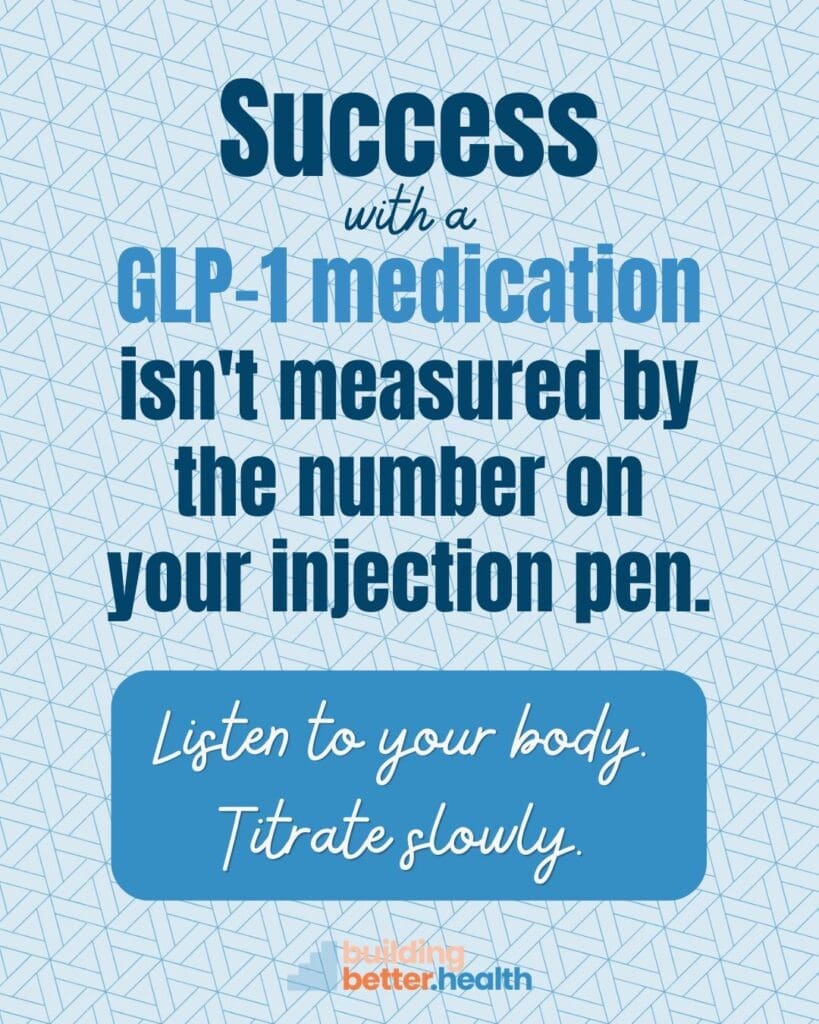
Because in the end, success with a GLP-1 medication isn’t measured by the number on your injection pen.
It’s measured by how healthy, confident, and sustainable your new lifestyle becomes.
MEDICAL DISCLAIMER: The content on this website is for educational and entertainment purposes only and should not be considered a substitute for professional medical advice, diagnosis, or treatment. Always consult a licensed healthcare provider before making any changes to your medications, treatments, diet, exercise regimen, or supplementation. The team at Building Better Health are not licensed medical professionals.
Please note: This website contains affiliate links. As an Amazon Associate, we earn from qualifying purchases at no additional cost to you.