

Please note: This website contains affiliate links. As an Amazon Associate, we earn from qualifying purchases at no additional cost to you.
QUICK ANSWER: When you lose weight on a GLP-1 like Zepbound or Wegovy, some of that loss is muscle — and after 65, protecting your muscle is the difference between ending up lighter and stronger versus lighter and weaker. The two tools that work: eating protein first at every meal, and strength-building movement a few times a week. This guide shows you exactly how to do both, even with a tiny appetite.
If you read my guide on starting a GLP-1 after 65, you know I called muscle protection “the big one.”
This is the article where we actually do something about it — the same plan I put together when my mother started considering Zepbound.
Why Muscle Is the Whole Ballgame After 65
Let me explain why I keep hammering this, because once it clicks, the rest of this article organizes itself.
Muscle isn’t about looking toned. After 65, muscle is what lets you get up from a low chair, catch yourself when you stumble, carry laundry up the stairs, and open a stubborn jar. It’s independence, measured in pounds of lean tissue.
And we’re all losing it naturally with age — research estimates 10–16% of adults over 60 already have meaningful age-related muscle loss, a condition doctors call sarcopenia (British Journal of Pharmacology).
Here’s where the medication comes in. When you lose weight — any way at all — your body doesn’t only burn fat. Some of what you lose is muscle. On GLP-1 medications, where weight can come off quickly and appetite shrinks dramatically, that muscle loss can add up if you’re not deliberate. Researchers studying older adults on these medications have flagged exactly this concern, including one longer-term study that found grip strength declined after about a year (BJP).
But — and this is the part that should make you feel hopeful, not scared — the research also points to a clear, doable prevention plan: adequate protein plus resistance-type activity (Nutrients review). Neither one requires a gym membership or a chef. Let’s build your version.
Part One: Protein First, Every Meal, No Exceptions
Here’s the challenge in one sentence: the medication shrinks your appetite to a few bites, so those bites have to count.
On a GLP-1, you might sit down to dinner and feel completely full after a third of your plate. If that plate was arranged the usual way — starch in the middle, protein on the side — you just filled up on rice and left the chicken behind.
Do that for six months and your body starts pulling from muscle to get the protein it needs.
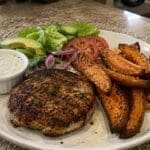
The fix is almost embarrassingly simple: rearrange the order you eat. Protein goes first, before anything else on the plate. Vegetables second. Starches last, if there’s room. You don’t have to eat less of anything on purpose — the medication handles portions. You just have to make sure fullness arrives after the protein is gone, not before.
What “protein first” looks like at real meals
- Breakfast: eggs before the toast. Greek yogurt before the granola. Cottage cheese with fruit stirred in, not fruit with a spoonful of cottage cheese.
- Lunch: the tuna, chicken, or egg salad before the crackers. Soup? Choose ones with meat or beans, and eat the solids first.
- Dinner: the salmon, pork chop, or chicken thigh before the potatoes. If you’re full after the protein, that’s a successful dinner.
- Rough days: when nausea makes solid food unappealing, protein still comes first — a protein shake, drinkable yogurt, or bone broth with a scrambled egg stirred in.
How much protein are we talking about?
Most nutrition research on older adults losing weight points toward more protein than the standard recommendation — not less — because your body becomes less efficient at using protein as you age, right when you need it most. The specific gram target depends on your weight, kidney health, and other conditions, so this is a number to set with your doctor — especially if you have any kidney issues, where protein targets genuinely change.
But here’s the practical translation that works for almost everyone: a palm-sized portion of protein at every meal, plus one protein-rich snack. If you do that every day, you’re in the neighborhood. If you want to count precisely, ask your doctor for your gram target, then use my guides to setting daily protein goals and what 100 grams of protein actually looks like on a GLP-1 — and grab my free [GLP-1 Protein Cheat Sheet](internal link: opt-in) so you can add things up without an app.
The over-65 protein pantry
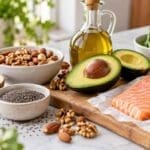
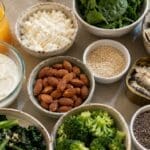
Stock these before your first dose. Every one of them is easy to prepare, easy on a sensitive stomach, and protein-dense enough that a few bites do real work:
- Eggs — the perfect GLP-1 food: cheap, gentle, cooked in five minutes
- Greek yogurt and cottage cheese — protein you can eat when nothing else sounds good
- Rotisserie chicken — zero cooking, a week of protein
- Canned tuna and salmon — shelf-stable, high protein, done in two minutes
- Deli turkey and string cheese — snack protein that requires no effort
- Protein shakes — your insurance policy for rough days (choose ones with 20+ grams and low sugar, or make your own with my protein shake recipes)
- Beans and lentils — protein plus the fiber that helps with the constipation side of these medications
For the complete stock-up list, I keep an ultimate GLP-1 shopping list that covers everything above and more.
Part Two: Strength Work That Doesn’t Require a Gym
Protein gives your body the raw material to keep muscle. Resistance gives it the reason to. Your body keeps what it uses — and lets go of what it doesn’t. During weight loss, muscle you aren’t using is exactly what your body economizes away.
The research in older adults backs this up: combining weight loss with resistance-type exercise is the most reliable way to shift the loss toward fat and away from muscle (Nutrients review).
“Resistance” sounds intimidating. It isn’t. It means your muscles pushing or pulling against something — your own body weight counts. Here’s a starting framework, but run it past your doctor first, especially if you have joint replacements, balance concerns, or heart conditions:
- Sit-to-stands. Stand up from a sturdy chair without using your hands, sit back down slowly. Repeat 8–10 times. This one exercise trains the exact muscles that keep you independent.
- Wall push-ups. Hands on the wall, lean in, push back. 8–10 repetitions.
- Resistance bands. Inexpensive, gentle on joints, and endlessly adjustable. Rows and presses with a band cover most of the upper body.
- Carrying things. Groceries, a watering can, a laundry basket — carrying weight is strength training hiding in plain sight. Do it deliberately.
- Two or three days a week is plenty. This is not about exhaustion. It’s about regularly reminding your muscles they’re needed. If you want a full routine built for this stage of life, my low-impact home workouts for seniors is the perfect companion to this plan.
If you already walk regularly — wonderful, keep going, walking is gold for your heart and mood. Just know that walking alone doesn’t send the “keep the muscle” signal the way resistance work does. The combination is the magic.
How to Tell It’s Working (Without Fancy Equipment)
The scale can’t see the difference between fat and muscle, so don’t rely on it alone. Track these instead — and mention them at your checkups, because they’re the same kinds of things doctors watch:
- The chair test: can you stand up from a chair without hands as easily as last month?
- Grip strength in real life: jars, doorknobs, carrying bags — same as always, or harder?
- The stairs: same effort, or more?
- Your energy through the day.
If any of these are clearly declining while the weight comes off, that’s not a failure — it’s information. Bring it to your doctor; the fix may be as simple as adjusting your protein, slowing the dose schedule, or adding one more day of strength work.
The Bottom Line
Losing weight after 65 on a GLP-1 isn’t just about the number going down — it’s about what you’re made of when you get there. Protein first at every meal. Resistance a few times a week. A doctor who knows that’s your plan. Do those three things and the research says you can have the weight loss and keep the strength that makes the weight loss worth having.
Next in this series: GLP-1 Side Effects After Age 65: Why They Hit Harder and What Actually Helps — because the number one reason older adults quit these medications is completely manageable stomach trouble, and I’d rather you be ready for it.
Sources: Nutrients — GLP-1 Receptor Agonists for Obesity in Older Women: Maximizing Weight Loss While Preserving Lean Mass · British Journal of Pharmacology — GLP-1 receptor agonists and muscle strength changes in older adults · AAMC — Are GLP-1 weight-loss drugs safe for older adults?
I’m not a doctor, and this article is not medical advice. It’s for informational purposes only, based on published research and my own experience as a Zepbound patient. Always talk with your healthcare provider before changing your diet, starting an exercise program, or making any medication decisions.
Please note: This website contains affiliate links. As an Amazon Associate, we earn from qualifying purchases at no additional cost to you.